



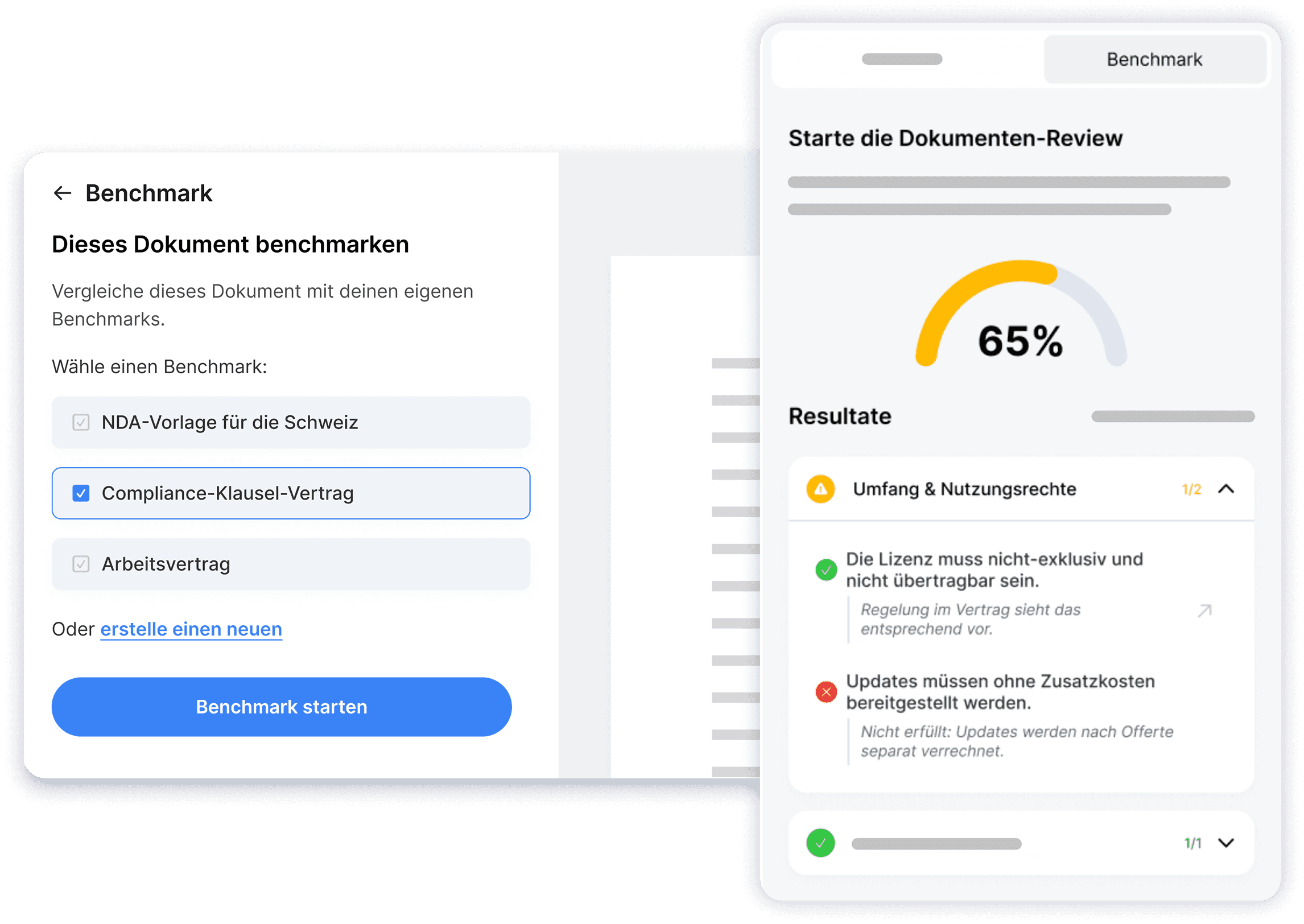
Identify missing clauses, mitigate risks, and standardize contract quality across the team
In many legal departments and law firms, risk doesn’t arise because someone negotiates poorly, but because day-to-day details slip through: a clause is missing, a standard position gets unintentionally diluted, or a contract uses terminology that doesn’t match internal standards. These small issues cost time later on – in renegotiations, escalations, or, in the worst case, disputes.
CASUS Benchmark solves this in a pragmatic way: contracts are systematically checked against your playbook. The tool identifies missing or insufficiently drafted standard clauses, flags deviations as risk findings, and provides concrete recommendations on how to close gaps – including suggestions on where a clause should be inserted.
Benchmark is available where contract work actually happens – in Microsoft Word. That means you can run a benchmark against your playbook, jump directly to the relevant clauses, and address findings right inside the document – without switching tools or copying content back and forth. You stay in the contract, keep full context, and move from findings to clean, playbook-compliant edits in one continuous workflow.
What does it mean to benchmark against a playbook?
At its core, a playbook is your standard: which clauses must be included in which contract types? Which positions are must-haves, which are negotiable – and where are the red lines?
Benchmarking means a contract isn’t just read, but compared to your standard. This makes review less subjective and far more scalable – especially when multiple team members with different experience levels are working on contracts.
Use Case 1: Identify missing clauses and automatically safeguard them
Many contract risks stem from gaps: topics aren’t addressed at all, or they’re drafted so vaguely that they offer little protection in a dispute. CASUS checks this in a structured way: Is the topic covered? And if yes – is it sufficiently drafted?
Typical issues that stand out quickly:
Missing topic areas such as data protection, termination, liability
Incomplete provisions such as liability without a cap, undefined IP ownership, or confidentiality without deletion obligations
Hidden gaps where something is mentioned, but doesn’t meet the internal standard in substance
The key difference compared to pure issue-spotting: for each gap, CASUS can provide a specific recommendation. Example: termination clause missing – option to automatically generate the clause and insert it in the right place with appropriate formatting.
That turns a finding into a clean next step.
Use Case 2: Ensure consistent quality across all contracts and team members
As soon as multiple people review or negotiate contracts, the same thing almost inevitably happens: standards drift. Some use the latest standard clause, others revert to older versions. Or one department uses different terminology than another. It seems minor – but over time it becomes a real governance and risk issue.
CASUS Benchmark helps ensure consistent quality by continuously checking documents against your playbook. This is especially valuable if you:
have a growing legal team,
work with templates regularly,
or process many similar contract types at high volume (e.g., MSAs, DPAs, procurement agreements, NDAs).
In practice, that means:
Deviations from standard wording are detected and output as concrete findings.
Terminology and structure are checked – including consistency notes.
Team-wide consistency is supported because playbook-compliant standard positions are available per topic.
The result: less discussion about “how we usually do it” – and more speed with the same level of legal quality.
Why this is especially interesting for Legal Ops
Benchmarking is essentially Legal Ops in its purest form: define standards, make quality measurable, and keep processes scalable.
For legal teams that want to act as true business partners, this is a lever with immediate impact: fewer repetitive loops, less firefighting, and a cleaner foundation for negotiations.
Conclusion
With CASUS Benchmark, you can systematically review contracts against your playbook: missing clauses are detected, incompleteness is flagged as risk findings, and deviations are made transparent. At the same time, you create a robust foundation to work to the same standards across the team – so contract quality doesn’t depend on chance or individual experience levels.
FAQ
What’s the advantage compared to a standard contract review?
A standard review depends heavily on time, focus, and experience. Benchmarking complements this by checking against defined standards in a structured way and making deviations consistently visible.
Can partially present clauses also be flagged as a risk?
Yes – especially in cases of incompleteness (e.g., liability without a cap, unclear IP ownership, confidentiality without deletion obligations). In practice, that’s often where the biggest risk arises.
Does this help with onboarding new team members?
Absolutely. Benchmarking makes standards tangible and reduces deviations. New team members learn faster what is playbook-compliant.
Is this only useful for large legal departments?
No. It pays off anywhere recurring contract types exist or multiple people work on contracts. Especially in smaller teams, it can save significant time by enforcing standards quickly and consistently.


