



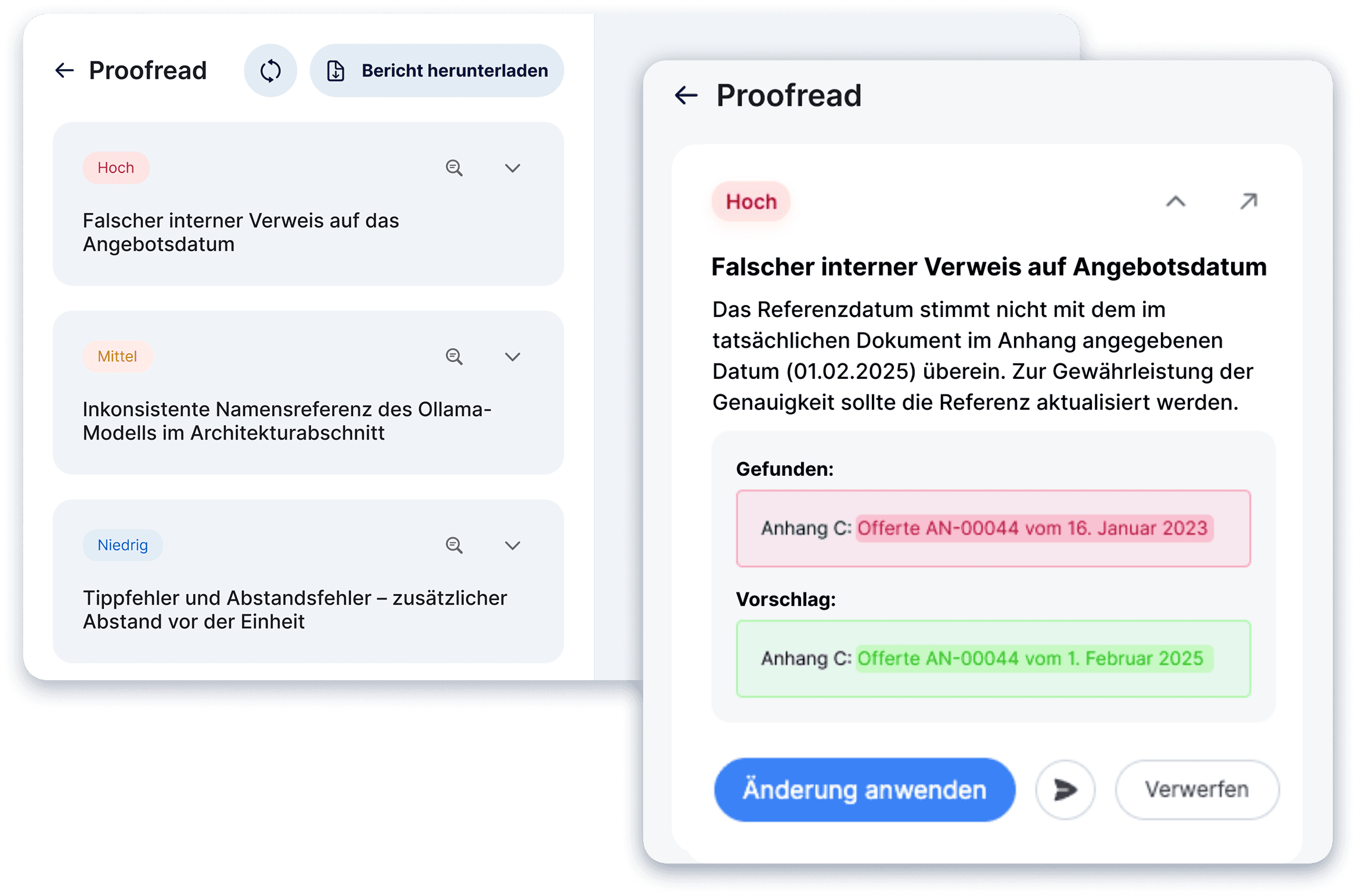
Error-free legal briefs and contracts – without changing legal meaning
Anyone who drafts or negotiates legal documents knows the problem: the substance is solid – but right before sending, small issues still pop up. Typos, inconsistent terminology, a wrong cross-reference, or a missing attachment. These “small” mistakes look unprofessional, create rework, and in the worst case can even cause misunderstandings.
That’s exactly where CASUS Proofread comes in: the tool checks texts linguistically and formally without altering the legal statement. It detects typical quality issues, validates cross-references, and provides a clear fix list before sending – so documents are consistent on the first pass.
CASUS Proofread is available where contract work actually happens – in Microsoft Word. That means you can run a proofread directly on the document, jump to the exact passages that need attention, and apply or refine suggestions right in place — without switching tools or copying text back and forth. You stay in the contract, keep full context, and move from language improvements to a clean, consistent, professional final version in one continuous workflow.
Formal quality in legal work
In legal, it’s not only what a document says – it’s also how reliable it appears. Especially with briefs, contracts, or templates that get reused, friction builds quickly:
follow-up questions because definitions or references are unclear
unnecessary iterations between Legal, the business team, and the counterparty
extra effort from “last-minute edits” that could actually be standardized
A structured quality check significantly reduces this – and lets the team focus more on substance, strategy, and negotiation.
Use Case 1: Ensure error-free briefs and contracts
CASUS checks spelling, grammar, and style – with one key principle: no substantive or legal meaning changes. The goal is clean phrasing, consistency, and a professional overall result.
Typical improvements that help immediately in practice:
Detecting typos, duplicate words, and awkward sentences – with concrete correction suggestions
Ensuring Swiss spelling conventions (e.g., ss instead of ß) and consistent spelling for parties and key terms
Flagging inconsistent terminology (e.g., “principal” vs “customer”, “services” vs “service”) including a recommendation to standardize
This doesn’t make documents “prettier at all costs” – it makes them clearer and more robust, especially when multiple people work on the same text or templates evolve over months.
Use Case 2: Check cross-references and internal references to avoid formal errors
Cross-references are among the most common pre-send mistakes: you move a section, add a clause number – and suddenly “see Section 7.2” points nowhere. In long contracts or briefs, this can happen quickly even with very careful work.
That’s why CASUS Proofread checks internal references systematically:
Section and clause references (e.g., the referenced section doesn’t exist or points to the wrong part)
Definitions and term references (e.g., a term is used but not defined; a definition exists but is spelled differently)
Annexes/exhibits/attachments (e.g., “Annex 2” is referenced but missing or incorrectly titled)
This is especially useful before internal approvals or before sending a document to the counterparty: fewer “embarrassing” correction rounds and a clean, traceable flow.
Use Case 3: Final checks before sending – fewer fixes, more confidence
Right before sending, the classic things happen: a placeholder remains, numbering breaks, two sections contradict each other because a late change was made – but not everywhere.
CASUS Proofread runs a final quality scan and produces a clear fix list, for example covering:
Numbering, heading hierarchy, and formatting consistency (duplicate numbers, jumps, inconsistent hierarchy)
Contradictions and last inconsistencies (e.g., term length or deadlines differ across sections)
Open items and placeholders (e.g., [●], “TBD”, empty fields, missing amounts or dates)
In day-to-day legal work, that’s invaluable: you’re not sending “the almost finished version” – you’re sending the version that’s truly ready to go.
Conclusion
With CASUS Proofread, you ensure briefs and contracts are linguistically clean, formally consistent, and internally coherent – without changing legal meaning. The combination of (1) language and quality checks and (2) cross-reference validation is particularly powerful. It saves time, reduces rework, and supports a professional standard – especially in Swiss document conventions.
FAQ
Does CASUS change the legal meaning when improving style and language?
No. The focus is on linguistic and formal corrections without reinterpreting the legal content.
Is Swiss spelling really a separate point?
Yes – in practice, consistency (e.g., ss instead of ß) and a uniform style are quality signals that stand out immediately, especially in external documents.
Why are cross-references so important?
Incorrect references look unprofessional and can lead to misunderstandings in the worst case. An automated check saves a lot of manual searching.
Which documents is this best suited for?
Anything that must be “ready to send”: contracts, briefs, statements, standard templates, annexes/attachments – especially longer documents or documents with multiple editors.


